
Today, her routine contains one thing newer and stranger: recording movies of new child infants.
“Earlier we needed to carry weighing scales and tapes, which was tough. Now, we simply carry the cellphone and it reveals us the child’s weight. Even in small villages, we will do correct measurement simply,” she says.
Patel is referring to Shishu Mapan, a synthetic intelligence (AI) software skilled on over 30,000 infants, constructed by scientists on the Wadhwani Institute for AI, a non-profit that develops AI-based options for social impression.
Utilizing a brief, arc-shaped video whereas the new child is undressed and laid on a material sheet, the app estimates the toddler’s weight and progress metrics, which eliminates the necessity for scales or guesswork.
Initially sceptical, staff and moms gained belief as soon as the app confirmed correct readings.
“Once we first instructed moms we’d measure the kid utilizing a cell phone, they thought we had been joking. However after they noticed the video and the load appeared on the app, they had been joyful. Now they lay the sheet down themselves and need to see if their child has gained weight,” says Patel.
Whereas most infants are weighed at start, follow-up checks in the course of the crucial first six weeks are patchy, particularly in rural and underserved areas. On this context, AI-powered instruments like Wadhwani AI’s app may develop into frontline necessities, able to remodeling little one well being outcomes the place the system usually falls brief. It additionally eases the burden on frontline well being staff, who usually wrestle to maintain up with excessive demand in rural areas.
Low start weight, outlined as infants weighing lower than 2.5kg at start, is among the most critical crimson flags in early childhood well being. These infants face the next danger of stunting, frequent infections and life-threatening malnutrition. Circumstances corresponding to marasmus, marked by excessive losing resulting from calorie deficiency, or Kwashiorkor, brought on by protein deficiency and leading to swelling, liver injury and immune suppression, are tragically widespread when detection is delayed. Correct progress monitoring within the first six weeks is usually the one probability to intervene earlier than it’s too late.

“ASHA staff are overworked, their instruments are outdated and there’s no digital record-keeping,” says Alpan Raval, chief scientist at Wadhwani institute of AI.
AI-powered options supply a approach ahead, offering correct and offline-friendly instruments that ease the burden on frontline staff and convey consistency to little one well being assessments.
Shishu Mapan started in 2019, when the Gates Basis approached the institute with a problem to develop an answer to precisely weigh low-birth-weight infants in rural India. After years of analysis and area testing, the pilot lastly launched in Daman and Diu final 12 months.
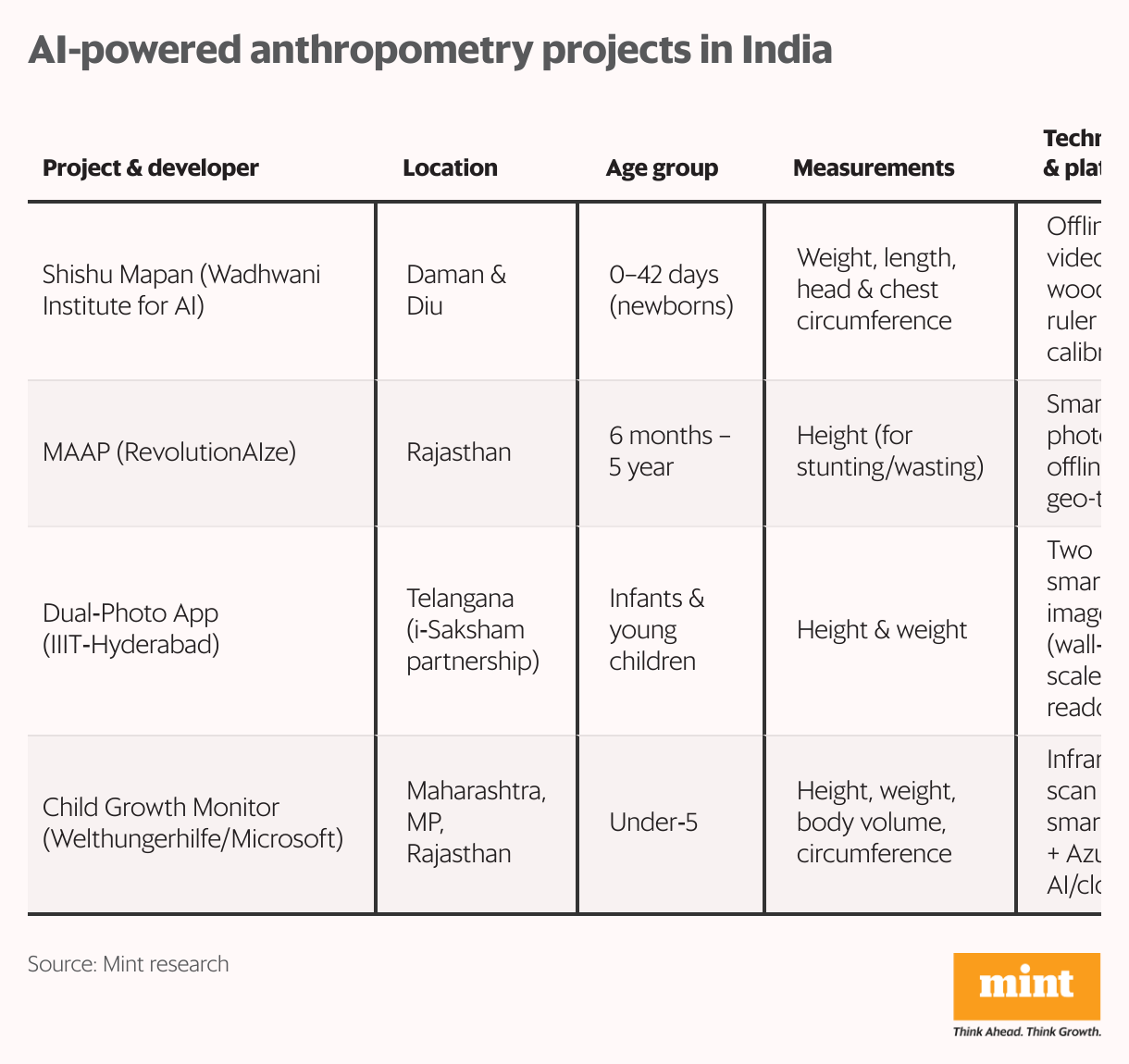
Throughout India, a brand new crop of AI-based instruments is being deployed to deal with persistent challenges in monitoring early childhood improvement, notably in low-resource settings. MAAP (Malnutrition Evaluation and Motion Plan) by social enterprise RevolutionAIze makes use of smartphone photographs to estimate top and flag malnutrition dangers. Researchers at IIIT-Hyderabad are testing a dual-photo methodology to estimate each top and weight utilizing primary visible cues. The Little one Development Monitor, developed by Welthungerhilfe with Microsoft, makes use of infrared 3D sensors to scan younger kids for anthropometric (measurement of the human physique) evaluation.
Every of those initiatives is completely different in scope, age vary and technical complexity, however they share a typical method of rethinking little one well being infrastructure by means of accessible AI that may be utilized on a big scale in densely populated areas.
Digital repair for a systemic hole
Neonatal healthcare in rural India faces challenges of entry, affordability and consciousness. Wadhwani’s software tackles this hole by means of early intervention. As soon as a child is discharged from a hospital, the dad and mom solely return for immunizations after six weeks, leaving underweight newborns uncovered to well being dangers. To handle this blind spot, India’s Dwelling-Primarily based New child Care (HBNC) programme requires ASHA staff to conduct residence visits throughout this era. ASHA staff usually assist establish underweight infants and in addition join new moms with authorities vitamin programmes. These programmes are important to forestall low start weight spiralling into continual undernutrition. However when weight information is lacking or inaccurate, these security nets usually miss probably the most weak.
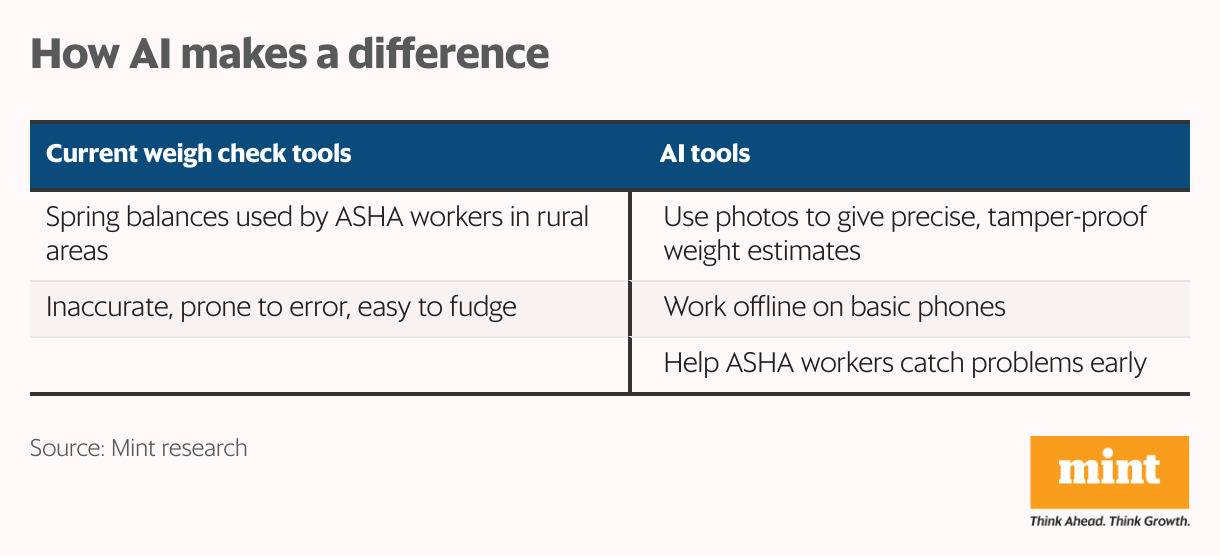
The instruments accessible to ASHAs, corresponding to sling-based Salter spring balances, aren’t fitted to this use case.
“The needle sparkles and ASHA staff wrestle to get a steady studying,” explains Dr. Sneha Nikam, a public well being skilled at Wadhwani AI. “That makes it arduous to detect points early or take well timed motion.”
The Shishu Mapan app is an easy resolution the place an ASHA employee locations the child subsequent to a picket ruler, data a brief video and lets the cellphone do the remaining. The app maps the child’s key factors and calculates weight, size and head circumference. The mannequin, optimized to run on low-end Android telephones and tolerate imperfect lighting or movement, works in offline mode with no need the web or cloud storage, making it efficient in rural areas with poor connectivity.

View Full Picture
Raval says the preliminary improvement of the mission started in hospitals the place managed lighting and backgrounds allowed the crew to show that the core thought of estimating weight from video was viable. Area deployment, nonetheless, required tweaks. As an example, as an alternative of a checkerboard for visible calibration, Wadhwani used a picket ruler that ASHA staff already carried.
Some dad and mom raised privateness considerations throughout exams, which the crew finally dealt with by storing movies domestically and deleting them after processing.
“We tried constructing a mannequin that might work on blurred faces, but it surely didn’t work. The AI would overestimate measurement,” he admits. The crew finally discovered a compromise the place movies are saved domestically and deleted instantly after processing. Solely inside annotators, certain by NDAs and dealing in safe rooms, see the uncooked footage.
In early 2024, the app was piloted in Daman and Diu. Native well being authorities built-in it into their PHMP (Proactive well being administration plan) platform, changing handbook weight entries.
The app’s margin of error, round 114 grams, is considerably decrease than spring balances, which might fluctuate by 183 grams. To account for potential over or underestimation, ASHA staff are instructed to refer infants even when their readings are barely above or beneath thresholds.
“If the AI says 1.9 kg, we nonetheless refer it to native hospitals, as a result of it may really be a 1.8 kg child,” says Nikam. Though it’s too early to evaluate the long-term impression on well being outcomes, preliminary suggestions suggests a shift in how early progress monitoring is being approached.
In keeping with Nikam, having digital logs provides to the accountability of ASHA staff and in addition supplies a clearer image. The rise in well timed referrals helps set off earlier interventions in areas corresponding to vitamin and sanitation.
Increasing AI instruments’ ecosystem
Whereas Wadhwani’s software focuses on the new child stage, MAAP picks up the place it leaves off—monitoring kids from six months onward.
Developed by social entrepreneur Romita Ghosh and information scientist Nilashis Roy underneath their social enterprise RevolutionAIze, MAAP makes use of a single smartphone picture to estimate top, assess dietary standing and recommend tailor-made meal plans.

View Full Picture
“Over 3.5 million severely malnourished kids in India go unscreened,” says Ghosh. “MAAP helps well being staff catch early indicators even within the remotest corners.”
Constructed for related working circumstances in rural India, MAAP’s software additionally works offline and is prop-free. The crew experimented with rulers, checkerboards and even Bisleri bottles for calibration earlier than instructing the AI to estimate scale from posture and environment.
Early challenges like poor lighting and picture angles led to a field-tested MAAP Guide and vernacular coaching movies. Ghosh says co-designing with ASHA and Anganwadi staff was important. “We didn’t simply construct it for them. We constructed it with them,” she says.
MAAP is free for presidency workers, whereas personal suppliers pay. This cross-subsidy helps preserve the product sustainable.
The information collected by means of the software is anonymized and doesn’t retailer any faces. The algorithm, then again, is continually up to date to mirror regional variety in physique proportions and pores and skin tones. Ghosh says the mannequin has earned international consideration with invites to current on the WHO and the AI for Good World Summit in Geneva.
In Telangana, IIIT-Hyderabad researchers are testing a dual-photo app that estimates top and weight utilizing markers corresponding to wall charts and scale shows. Nonetheless within the pilot part, it reveals potential for institutional settings however requires tighter protocols. In the meantime, the Little one Development Monitor developed by Welthungerhilfe and Microsoft makes use of 3D infrared cameras to create full-body scans of youngsters underneath 5. The mannequin is correct and hardware-driven, however its excessive price and dependency on sensors restrict its area adaptability.
The street forward
Wadhwani AI’s subsequent step is to increase its anthropometry mannequin to cowl kids as much as six years previous. Prasaanth Balraj, product supervisor on the institute, who additionally oversees its work on tuberculosis and maternal well being, instructed Mint that the ministry of girls and little one improvement has requested this enlargement to combine the software with the Poshan Tracker, India’s nationwide little one vitamin information platform.
“This may require retraining the mannequin to precisely assess older kids, whose motion patterns and physique proportions differ considerably from newborns,” says Balraj.
Wadhwani AI can be getting ready to roll out pilots in different states, with Arunachal Pradesh among the many first. The crew has begun the method of contextualizing the mannequin for regional variations in lighting, pores and skin tone and toddler look. Area groups are supporting this with coaching, technical setup and suggestions loops.
“In lots of testing websites, that is the primary time we’re seeing such information on toddler progress being captured and shared upward in close to actual time,” says Balraj.
For Romita Ghosh, whose work by means of MAAP focuses on the broader problem of figuring out malnourished kids, the long-term impression depends upon integrating AI into present public methods moderately than creating parallel ones.
“You don’t transfer mountains with tech alone. You do it with coverage, partnerships and endurance,” she says.
MAAP flags early malnutrition dangers and suggests meal plans tailor-made to native diets. By embedding the software into present authorities workflows and providing it free to public well being staff whereas subsidizing prices by means of personal companions, Ghosh says they’re aiming to “transfer the needle” on India’s malnutrition disaster.
Whether or not it’s MAAP’s pose-estimation mannequin, IIIT-Hyderabad’s dual-photo software or Wadhwani’s new child weight app, the instruments can have a bigger impression after they combine into the system. Therefore they’re being designed to work offline, on primary telephones and inside routines that frontline staff already observe.
Scaling AI for healthcare
Sumedha Sircar, a public well being researcher with a public well being diploma from Harvard and founding father of Liger India, has labored extensively on deploying AI for cervical most cancers screening in rural Bihar and Jharkhand.
“Anthropometry is less complicated. It needs to be potential to construct dependable AI round it, particularly one that offers standardized, repeatable leads to rural settings,” she says.
Past accuracy, Sircar emphasizes the potential for AI to enhance information reliability.
“ASHA staff are overburdened and infrequently have to fulfill targets. A smartphone software that requires visible inputs makes information tougher to fudge than paper entries,” she says.
A smartphone software that requires visible inputs makes information tougher to fudge than paper entries.
— Sumedha Sircar
Sircar suggests increasing the ASHA workforce and utilizing AI to embed native coaching and suggestions loops, so staff can report points or share successes with out ready for top-down interventions.
Shally Awasthi, head of the paediatrics division at King George’s Medical college and a member of the World Well being Group’s advisory group, says AI-based interventions have large potential in detection of malnutrition and undernutrition in areas with restricted entry to skilled paediatricians. In addition they have a job to play in areas manned by healthcare professionals who’re both too busy to give attention to anthropometry and its interpretation and observe up, or haven’t been skilled in paediatrics, she says.
“AI intervention for detection should be supported by services for motion and follow-up at a clinic near their residence,” says Awasthi. “The observe ups can’t be executed successfully by AI as plenty of private teaching and handholding will probably be wanted for a very long time.”
In different phrases, AI is just not a silver bullet. However it could have a massively constructive impression on thousands and thousands of lives whether it is complemented by adjustments in apply and coverage.
Key Takeaways
- Low start weight is among the most critical crimson flags in early childhood.
- These infants face the next danger of stunting, infections and malnutrition.
- Whereas most infants are weighed at start, follow-up checks in the course of the crucial first six weeks are patchy, particularly in rural and underserved areas.
- A brand new crop of instruments needs to rethink little one well being infrastructure by means of accessible synthetic intelligence.
- The AI-powered instruments may develop into frontline necessities.
- It may additionally ease the burden on well being staff who usually wrestle to maintain up with excessive demand.
========================
AI, IT SOLUTIONS TECHTOKAI.NET